


Why does California collect information about Preschool Outcomes?
The Individuals with Disabilities Education Improvement Act 2004 (IDEA) included a heightened emphasis on accountability, focusing on improving educational results for children with disabilities. IDEA 2004 directs states to develop a State Performance Plan (SPP) and to submit Annual Performance Reports (APRs) related to the Indicators specified in the SPP. Each SPP Indicator contains information such as baseline data and measurable and rigorous targets. Indicator 7, Preschool Outcomes, of the SPP focuses on measuring the developmental and functional skills of preschool children with Individualized Education Programs (IEPs) across three federally defined outcome areas.
Since 2007, Special Education Local Plan Areas (SELPAs) have reported (CDE/SED) on preschool-aged children’s progress by implementing the Desired Results Developmental Profile (DRDP) assessment. DRDP data is used for the SPP/APR reporting according to the requirements of the federal Office of Special Education Programs (OSEP). This document describes the relationship between the DRDP and the SPP/APR.
What is the Indicator 7 of the SPP/APR?
Each year the CDE, SED reports on Indicator 7 of the SPP to OSEP. OSEP then determines how well the state’s programs have helped 3, 4, and 5 year olds in early childhood special education programs make progress in three key outcome areas of early learning and development. The CDE, SED uses the information to determine whether local school district programs are making a positive difference for young children in California and their families.
The three key outcome areas measured in Indicator 7 are:
- OSEP 1: Positive social-emotional skills (including social relationships);
- OSEP 2: Acquisition and use of knowledge and skills (including early language/communication and early literacy); and
- OSEP 3: Use of appropriate behaviors to meet their needs.
Source: The Early Childhood Outcomes Center (https://ectacenter.org/~pdfs/eco/three-child-outcomes-breadth.pdf)
What information fulfills the requirements for Indicator 7?
In California, SELPAs report DRDP assessment data to the CDE, SED for all 3, 4 and 5 year old children with IEPs1 (including those in Transitional Kindergarten and Kindergarten) each fall and spring. These data are used to fulfill the requirements for Indicator 7.
The DRDP is an observational assessment for children birth through five years of age and is comprised of developmental and pre-academic domains representing important areas of learning and development. Administering the DRDP twice a year provides a picture of how the child progresses over time.
* Detailed information on California State Performance Plan can be found at: http://www.cde.ca.gov/sp/se/qa/
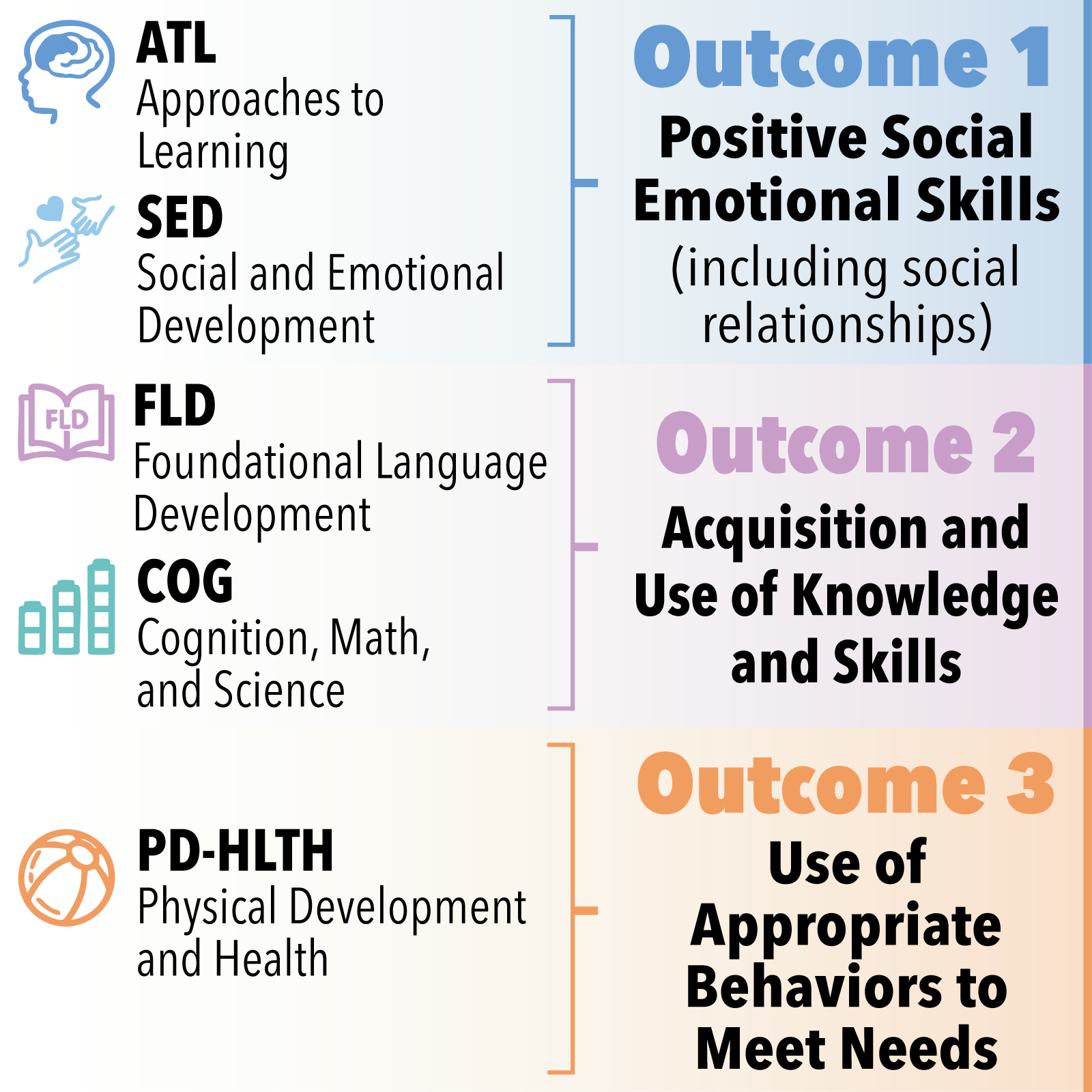 How is DRDP data aligned to the Indicator 7 Outcome Areas?
[The image here illustrates this alignment as follows: ALT (Approaches to Learning) and SED (Social and Emotional Development) Indicators align with Outcome A: Positive social-emotional skills. FLD (Foundational Language Development) and COG (Cognition, Math, and Science) Indicators align with Outcome B: Acquisition and use of knowledge and skills. PD-HLTH (Physical Development and Health) Indicator aligns with Outcome C: Use of appropriate behaviors to meet needs.]
The DRDP domains are grouped to align to the three Indicator 7 preschool outcomes. Figure 1 illustrates this alignment.
How is DRDP data used to measure progress?
For each of the preschool outcomes, DRDP data is used to establish “entry” and “exit” scores for every child assessed. Each child’s DRDP data at the time of entry into special education services are compared to the data at exit from special education services using this process:
- These data are reviewed to identify an “entry” assessment for every child.
- “Entry” and “exit” DRDP assessments are matched and compared for the Indicator 7 analyses.
Additional Information
For more information about Indicator 7 of the SPP, visit these websites:
- The U.S. Department of Education at https://sites.ed.gov/idea/spp-apr/
- The California Department of Education at https://www.cde.ca.gov/sp/se/leadatarpts.asp
- The Early Childhood Technical Assistance Center at http://ectacenter.org/
- The Center for IDEA Early Childhood Data Systems at http://dasycenter.org/
To view Indicator 7 results for the state, SELPA or district, visit DRAccessOutcomes.org
If You Need Support
DR Access Project
Email: info@draccess.org
Phone: 800-673-9220
DR Access Reports
Email: reports@draccess.org
Phone: 800-673-9220