


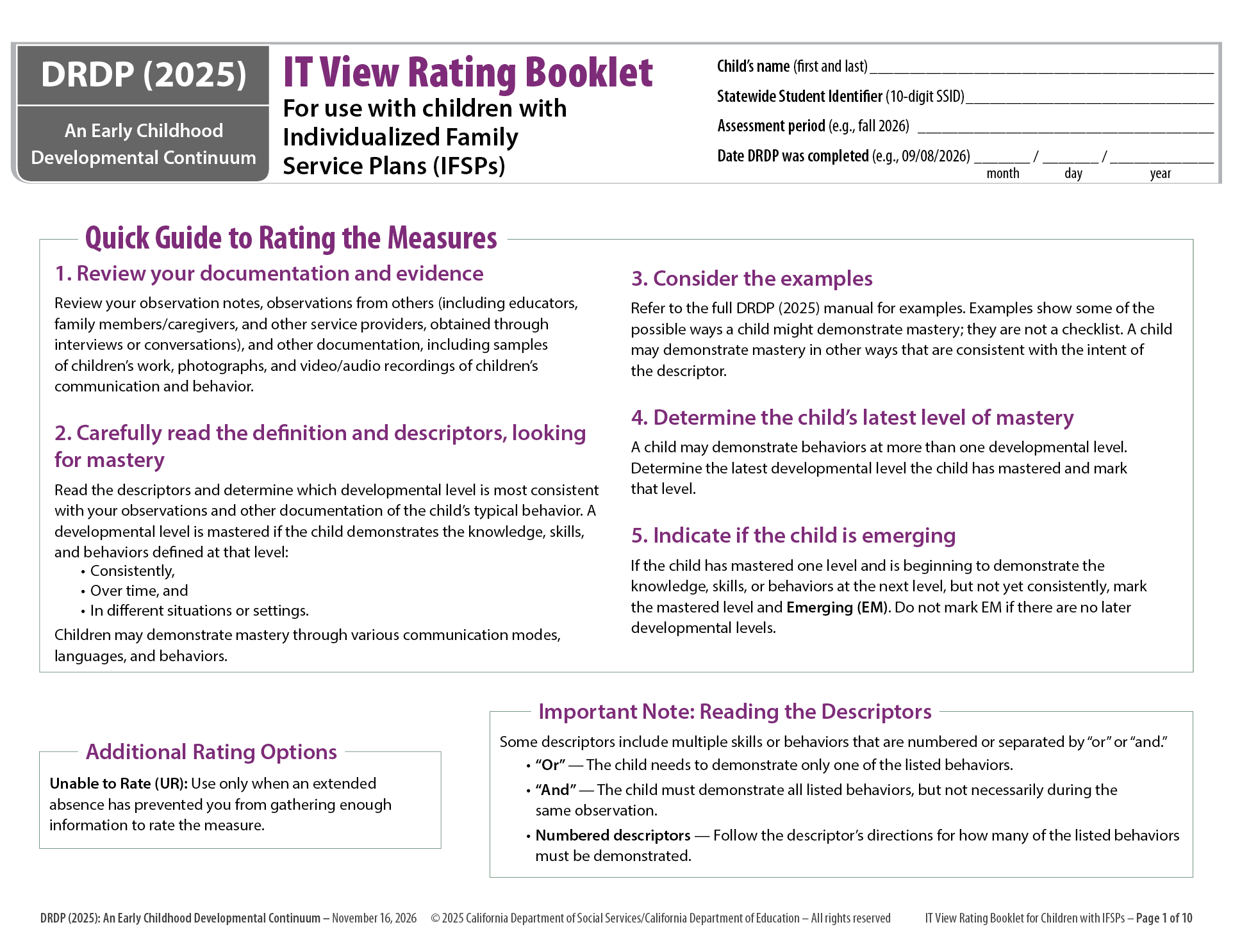
An Early Childhood Developmental Continuum
For use with children with Individualized Family Service Plans (IFSPs)
Child and Assessment Information
- Child’s name (first and last)
- Statewide Student Identifier (10-digit SSID)
- Assessment period (e.g., fall 2026)
- Date DRDP was completed (month/day/year; e.g., 09/08/2026)
Quick Guide to Rating the Measures
Review your documentation and evidence
Review your observation notes, observations from others (including educators, family members/caregivers, and other service providers, obtained through interviews or conversations), and other documentation, including samples of children’s work, photographs, and video/audio recordings of children’s communication and behavior.
Carefully read the definition and descriptors, looking for mastery
Read the descriptors and determine which developmental level is most consistent with your observations and other documentation of the child’s typical behavior. A developmental level is mastered if the child demonstrates the knowledge, skills, and behaviors defined at that level:
- Consistently,
- Over time, and
- In different situations or settings.
Children may demonstrate mastery through various communication modes, languages, and behaviors.
Consider the examples
Refer to the full DRDP (2025) manual for examples. Examples show some of the possible ways a child might demonstrate mastery; they are not a checklist. A child may demonstrate mastery in other ways that are consistent with the intent of the descriptor.
Determine the child’s latest level of mastery
A child may demonstrate behaviors at more than one developmental level. Determine the latest developmental level the child has mastered and mark that level.
Indicate if the child is emerging
If the child has mastered one level and is beginning to demonstrate the knowledge, skills, or behaviors at the next level, but not yet consistently, mark the mastered level and Emerging (EM). Do not mark EM if there are no later developmental levels.
Additional Rating Options
Unable to Rate (UR): Use only when an extended absence has prevented you from gathering enough information to rate the measure.
Important Note: Reading the Descriptors
Some descriptors include multiple skills or behaviors that are numbered or separated by “or” or “and.”
- “Or” — The child needs to demonstrate only one of the listed behaviors.
- “And” — The child must demonstrate all listed behaviors, but not necessarily during the same observation.
- Numbered descriptors — Follow the descriptor’s directions for how many of the listed behaviors must be demonstrated.
ATL — Approaches To Learning
ATL 1: Engagement, Attention, and Persistence
Child develops increasing ability to engage by sustaining attention, contributing, and persisting, when appropriate, related to learning activities
Additional rating options: Emerging (EM); Unable to Rate (UR).
| Developmental level | Descriptor |
|---|---|
| Responding Earlier | Orients to people, objects, or changes in the environment |
| Responding Later | Engages in explorations of people or objects for brief periods |
| Exploring Earlier | Engages in simple self-initiated activities, sometimes with adult support |
| Exploring Later | Engages in and returns to self-initiated activities after a brief interruption |
| Building Earlier | Engages in self-initiated activities for extended periods of time |
ATL 2: Curiosity, Interest, and Initiative
Child develops increasing capacity to explore objects, activities, or ideas and takes initiative to seek information and understanding
Additional rating options: Emerging (EM); Unable to Rate (UR).
| Developmental level | Descriptor |
|---|---|
| Responding Earlier | Orients toward movement or changes in people, objects, or sounds |
| Responding Later | Shows interest in new or unexpected characteristics or actions of people or objects |
| Exploring Earlier | Explores objects and notices and responds to interactions with people |
| Exploring Later | Explores new ways to use familiar objects outside of their intended use |
| Building Earlier | Explores self-selected ideas, objects, or events by manipulating, or asking simple “what” or “where” questions |
ATL 3: Problem-Solving
Child develops increasing ability to come up with, adjust, and reflect on strategies to solve everyday problems and problems related to learning activities
Additional rating options: Emerging (EM); Unable to Rate (UR).
| Developmental level | Descriptor |
|---|---|
| Responding Earlier | Orients toward people, sounds, or objects |
| Responding Later | Explores doing things with people or objects and attends to what happens |
| Exploring Earlier | Tries different ways to do things using people or objects when encountering problems |
| Exploring Later | Uses effective strategies, suggested by others or observed, to solve problems |
| Building Earlier | Comes up with strategies to solve everyday problems, with adult support |
SED — Social and Emotional Development
SED 1: Self-Awareness
Child shows increasing awareness of own identity and preferences as distinct from and in relation to others
Additional rating options: Emerging (EM); Unable to Rate (UR).
| Developmental level | Descriptor |
|---|---|
| Responding Earlier | Responds to others |
| Responding Later | Uses senses and movement to explore self and others |
| Exploring Earlier | Responds to their own name or nickname |
| Exploring Later | Communicates own needs and wants |
| Building Earlier | Expresses simple ideas about self and connection to others |
SED 2: Social Awareness
Child shows a developing awareness and acceptance of others’ thoughts, perspectives, and individual characteristics
Additional rating options: Emerging (EM); Unable to Rate (UR).
| Developmental level | Descriptor |
|---|---|
| Responding Earlier | Responds to faces, voices, or actions of other people |
| Responding Later | Anticipates what familiar people will do in repeated experiences such as care routines |
| Exploring Earlier | Shares a common focus with another person |
| Exploring Later | Acts in response to what they think another person wants |
| Building Earlier | Communicates about others’ feelings, behaviors, or preferences |
SED 3: Relationships and Reciprocal Interactions with Familiar Adults
Child develops close relationships with one or more familiar adults (including family members) and interacts in an increasingly competent and cooperative manner with familiar adults
Additional rating options: Emerging (EM); Unable to Rate (UR).
| Developmental level | Descriptor |
|---|---|
| Responding Earlier | Responds to faces, voices, or actions of people nearby |
| Responding Later | Shows interest in familiar adults |
| Exploring Earlier | Shows a preference for interacting with familiar adults over unfamiliar adults |
| Exploring Later | Participates in familiar routines and activities with familiar adults |
| Building Earlier | Interacts for extended periods with familiar adults in a variety of situations |
SED 4: Relationships and Interactions with Peers
Child develops and maintains close relationships with one or more peers and becomes increasingly competent and cooperative in peer interactions
Additional rating options: Emerging (EM); Unable to Rate (UR).
| Developmental level | Descriptor |
|---|---|
| Responding Earlier | Shows awareness of other people, including children |
| Responding Later | Shows interest in nearby children |
| Exploring Earlier | Indicates interest in being near peers and orients own activity to a peer’s activity |
| Exploring Later | Engages with peers in brief back-and-forth of objects, actions, or words |
| Building Earlier | Plays together with various peers for brief amounts of time, when initiated or supported by an adult |
SED 5: Emotional Knowledge and Regulation
Child develops an increasing ability to identify and process emotions
Additional rating options: Emerging (EM); Unable to Rate (UR).
| Developmental level | Descriptor |
|---|---|
| Responding Earlier | Calms in response to care from a familiar adult |
| Responding Later | Orients to a familiar adult when distressed and responds when comforted by them |
| Exploring Earlier | Shows preference for certain familiar adults for comfort and care |
| Exploring Later | Comforts self or seeks comfort from familiar adults |
| Building Earlier | Seeks out familiar adults for support when experiencing an emotion |
FLD — Foundational Language Development
FLD 1: Understanding Language (Receptive)
Child understands increasingly complex language, including vocabulary in home language, English, sign language, or Augmentative and Alternative Communication (AAC)
Additional rating options: Emerging (EM); Unable to Rate (UR).
| Developmental level | Descriptor |
|---|---|
| Responding Earlier | Responds to sounds or sights nearby in the environment |
| Responding Later | Orients toward the source of sounds or tracks sights in the environment, including familiar voices or faces |
| Exploring Earlier | Shows understanding that communication with gestures, words, or signs carries meaning |
| Exploring Middle | Shows understanding of a variety of single words in their environment |
| Exploring Later | Shows understanding of frequently used simple phrases or sentences, in the present |
| Building Earlier | Shows understanding of phrases or sentences, including those referring to the past or future |
FLD 2: Using Language (Expressive)
Child uses increasingly complex language, including vocabulary, sentences, questions, narratives, and explanations, in their home language, English, sign language, or Augmentative and Alternative Communication (AAC)
Additional rating options: Emerging (EM); Unable to Rate (UR).
| Developmental level | Descriptor |
|---|---|
| Responding Earlier | Makes sounds or moves hands spontaneously |
| Responding Later | Makes sounds, gestures, or facial expressions with intention |
| Exploring Earlier | Uses vocal sounds with multiple syllables or hand movements in language-like sequences with the intention to communicate |
| Exploring Middle | Uses a growing variety of single words, word approximations, signs, words and signs together, conventional gestures, or symbols to communicate |
| Exploring Later | Combines two words, signs, a word and a sign, or symbols to communicate simple ideas |
| Building Earlier | Uses phrases and sentences of more than two words, signs, words and signs together, or symbols, including a variety of nouns, verbs, or pronouns to communicate |
FLD 3: Shared Communication and Conversation
Child engages in back-and-forth communication with shared focus in increasingly extended conversations, using home language, English, sign language, or Augmentative and Alternative Communication (AAC)
Additional rating options: Emerging (EM); Unable to Rate (UR).
| Developmental level | Descriptor |
|---|---|
| Responding Earlier | Responds to others |
| Responding Later | Pays attention when an adult communicates to them |
| Exploring Earlier | Imitates adult speech sounds or signs and engages in turn-taking through vocalization, gestures, or eye gaze |
| Exploring Middle | Uses single gestures, words, or signs to take turns in brief back-and-forth communication with adults, including responding to simple questions |
| Exploring Later | Uses combinations of words, gestures, and signs to take turns in brief back-and-forth communication |
| Building Earlier | Engages in brief conversations on topic for several turns, sharing opinions and thoughts |
COG — Cognition
COG 1: Imitation
Child repeats and practices the actions or words of others in increasingly complex ways
Additional rating options: Emerging (EM); Unable to Rate (UR).
| Developmental level | Descriptor |
|---|---|
| Responding Earlier | Responds to facial expressions, vocalizations, or touch |
| Responding Later | Tries to imitate single simple actions or sounds when interacting with others |
| Exploring Earlier | Repeats others’ familiar actions, gestures, or words soon after they occur |
| Exploring Later | Repeats others’ familiar actions, gestures, or words experienced at an earlier time |
| Building Earlier | Repeats multiple step actions, gestures, words, or phrases experienced at an earlier time |
MATH — Math
MATH 1: Spatial Thinking
Child shows increasing understanding of objects in relation to each other and how objects move in space
Additional rating options: Emerging (EM); Unable to Rate (UR).
| Developmental level | Descriptor |
|---|---|
| Responding Earlier | Responds physically to experiences in their immediate environment |
| Responding Later | Explores, responds to, and acts on objects, people, or own body movements through space |
| Exploring Earlier | Explores the relationship between self and objects or people in space |
| Exploring Later | Uses trial and error to make discoveries about spatial relationships or movement of self or objects through space |
| Building Earlier | Takes into account spatial relationships and physical properties when exploring possibilities of fitting objects together |
MATH 2: Classification
Child shows increasing ability to sort objects into groups according to attributes, qualities, features, characteristics, or use
Additional rating options: Emerging (EM); Unable to Rate (UR).
| Developmental level | Descriptor |
|---|---|
| Responding Earlier | Attends to people, objects, or events |
| Responding Later | Interacts differently with familiar people and objects than with unfamiliar people and objects |
| Exploring Earlier | Associates a person or object with another person or object, based on a similarity or relationship between them |
| Exploring Later | Demonstrates understanding of the similarities of a group of objects based on one attribute or the relationship between them |
| Building Earlier | Sorts objects into two groups based on one attribute, but not always accurately |
MATH 3: Number and Counting
Child shows developing understanding of number and quantity
Additional rating options: Emerging (EM); Unable to Rate (UR).
| Developmental level | Descriptor |
|---|---|
| Responding Earlier | Notices people or objects nearby in the environment |
| Responding Later | Explores one object at a time |
| Exploring Earlier | Attends to quantity in different situations |
| Exploring Later | Uses number words, signs, or gestures to communicate about small quantities |
| Building Earlier | Demonstrates one of the following within quantities of 20:
|
SCI — Science
SCI 1: Cause and Effect
Child develops increasing ability to observe, anticipate, and reason about the cause-and-effect relationships between actions and events
Additional rating options: Emerging (EM); Unable to Rate (UR).
| Developmental level | Descriptor |
|---|---|
| Responding Earlier | Responds or shows anticipatory excitement to people, objects, or actions |
| Responding Later | Repeats the same action with the same objects or people that produced an effect |
| Exploring Earlier | Repeats the same action with different objects or people |
| Exploring Later | Explores possible causes of actions or events |
| Building Earlier | Acts on objects based on their features |
SCI 2: Inquiry Through Observation and Investigation
Child develops increasing ability to carry out observations, explorations, and investigations in the environment
Additional rating options: Emerging (EM); Unable to Rate (UR).
| Developmental level | Descriptor |
|---|---|
| Responding Earlier | Responds to people, things, or sounds |
| Responding Later | Shows interest in people or things in the environment |
| Exploring Earlier | Attends to responses of objects or people that result from own actions |
| Exploring Later | Engages in simple, purposeful explorations of familiar objects in the environment |
| Building Earlier | Engages in extended explorations of objects and events in the environment |
PD — Physical Development
PD 1: Perceptual-Motor Skills and Movement Concepts
Child moves body and interacts with the environment, demonstrating increasing body awareness, spatial awareness, and directional awareness*
*May be demonstrated while using a stability aid such as a stander or a mobility aid such as a walker or a wheelchair.
Additional rating options: Emerging (EM); Unable to Rate (UR).
| Developmental level | Descriptor |
|---|---|
| Responding Earlier | Responds to sensory information or input (e.g., visual, auditory, tactile) with basic movements of body parts |
| Responding Later | Responds to sensory information by moving body or limbs to reach for or move toward people or objects |
| Exploring Earlier | Uses sensory information to control body while exploring people, objects, or changes in the physical environment |
| Exploring Later | Adjusts posture and movements in response to the physical environment while moving from one place to another or trying to do a task |
| Building Earlier | Demonstrates body awareness by coordinating some movements of body parts in response to the physical environment |
PD 2: Gross Locomotor Movement Skills
Child shows increasing proficiency in fundamental locomotor skills (e.g., rolling, crawling, cruising, walking, running, jumping, galloping)*
*May be demonstrated while using a stability aid such as a stander or a mobility aid such as a walker or a wheelchair.
Additional rating options: Emerging (EM); Unable to Rate (UR).
| Developmental level | Descriptor |
|---|---|
| Responding Earlier | Turns head, and moves arms and legs, moving in response to touch, sound, or movement nearby |
| Responding Later | Holds head and torso upright against gravity |
| Exploring Earlier | Coordinates movements of whole body to move into and out of positions, crawl, or scoot on bottom |
| Exploring Middle | Coordinates movements of whole body while upright, using support, to move from one place to another |
| Exploring Later | Coordinates movement of whole body while upright to move from one place to another |
| Building Earlier | Coordinates movement of the whole body to move off the ground momentarily |
PD 3: Gross Motor Manipulative Skills
Child shows increasing proficiency in gross motor manipulative skills (e.g., reaching, kicking, throwing, and catching)*
*May be demonstrated while using a stability aid such as a stander or a mobility aid such as a walker or a wheelchair.
Additional rating options: Emerging (EM); Unable to Rate (UR).
| Developmental level | Descriptor |
|---|---|
| Responding Earlier | Orients to nearby objects |
| Responding Later | Uses arms, legs, or body to move toward, reach for, or mouth objects or people |
| Exploring Earlier | Uses arms, legs, or body to engage in simple, repeated actions on objects and Manipulates objects differently based on their properties |
| Exploring Middle | Uses arms, legs, or body to manipulate objects while maintaining stability in positions such as sitting, kneeling, or standing |
| Exploring Later | Engages whole body in movements that involve back and forth activities, such as pushing and pulling, with limited stability |
| Building Earlier | Manipulates objects using arms, legs, or body, with stability but limited coordination |
PD 4: Fine Motor Manipulative Skills
Child demonstrates increasing precision, strength, coordination, and efficiency when using muscles of the hand for play and functional tasks
Additional rating options: Emerging (EM); Unable to Rate (UR).
| Developmental level | Descriptor |
|---|---|
| Responding Earlier | Moves arms and hands |
| Responding Later | Uses arms or hands to make contact with objects in the environment |
| Exploring Earlier | Grasps objects with hand |
| Exploring Middle | Grasps objects with fingers and thumb |
| Exploring Later | Explores ways to use one hand, or to use both hands doing the same movements, to manipulate objects |
| Building Earlier | Acts on objects with one hand, while stabilizing the objects with the other hand or with another part of body |
HLTH — Health
HLTH 1: Safety
Child shows increasing awareness of safety and increasingly demonstrates knowledge of safety skills
Additional rating options: Emerging (EM); Unable to Rate (UR).
| Developmental level | Descriptor |
|---|---|
| Responding Earlier | Reacts to unpleasant events (e.g., sounds, touch) |
| Responding Later | Responds to situations that feel unsafe |
| Exploring Earlier | Seeks a familiar adult in situations that feel unsafe |
| Exploring Later | Follows adults’ guidance about basic safety practices |
| Building Earlier | Follows basic safety practices in familiar situations with adult supervision |
HLTH 3: Personal Care Routines: Hygiene
Child increasingly responds to and initiates personal care routines that support hygiene
Additional rating options: Emerging (EM); Unable to Rate (UR).
| Developmental level | Descriptor |
|---|---|
| Responding Earlier | Responds in basic ways during personal care routines that involve hygiene |
| Responding Later | Responds in ways that demonstrate awareness of a hygiene routine |
| Exploring Earlier | Anticipates one or two steps of a hygiene routine |
| Exploring Later | Participates in own hygiene routines, with an adult |
| Building Earlier | Carries out some steps of own hygiene routines, with specific adult guidance or demonstration |
HLTH 4: Personal Care Routines: Feeding
Child responds to feeding and feeds self with increasing proficiency
Additional rating options: Emerging (EM); Unable to Rate (UR).
| Developmental level | Descriptor |
|---|---|
| Responding Earlier | Responds in basic ways during feeding |
| Responding Later | Engages in the process of being fed |
| Exploring Earlier | Feeds self some food items using fingers or hands |
| Exploring Later | Explores the use of tools when feeding self, sometimes with adult support |
| Building Earlier | Feeds self different types of foods, some of which may involve the use of tools |
HLTH 5: Personal Care Routines: Self-Dressing
Child develops and refines ability to participate in and take responsibility for dressing self
Additional rating options: Emerging (EM); Unable to Rate (UR).
| Developmental level | Descriptor |
|---|---|
| Responding Earlier | Responds in basic ways during dressing |
| Responding Later | Responds in ways that demonstrate awareness of a dressing routine |
| Exploring Earlier | Anticipates one or two steps of a dressing routine |
| Exploring Later | Participates with adult in dressing self |
| Building Earlier | Puts on clothing that is simple to manipulate, sometimes with adult assistance |